Tutorial: Solution of the heat equation with Neumann boundary conditions
Similar to the tutorial on linear advection, we will demonstrate how to solve a conservative production-destruction system (PDS) resulting from a PDE discretization and means to improve the performance.
Definition of the conservative production-destruction system
Consider the heat equation
\[\partial_t u(t,x) = \mu \partial_x^2 u(t,x),\quad u(0,x)=u_0(x),\]
with $μ ≥ 0$, $t≥ 0$, $x\in[0,1]$, and homogeneous Neumann boundary conditions. We use a finite volume discretization, i.e., we split the domain $[0, 1]$ into $N$ uniform cells of width $\Delta x = 1 / N$. As degrees of freedom, we use the mean values of $u(t)$ in each cell approximated by the point value $u_i(t)$ in the center of cell $i$. Finally, we use the classical central finite difference discretization of the Laplacian with homogeneous Neumann boundary conditions, resulting in the ODE
\[\partial_t u(t) = L u(t), \quad L = \frac{\mu}{\Delta x^2} \begin{pmatrix} -1 & 1 \\ 1 & -2 & 1 \\ & \ddots & \ddots & \ddots \\ && 1 & -2 & 1 \\ &&& 1 & -1 \end{pmatrix}.\]
The system can be written as a conservative PDS with production terms
\[\begin{aligned} &p_{i,i-1}(t,\mathbf u(t)) = \frac{\mu}{\Delta x^2} u_{i-1}(t),\quad i=2,\dots,N, \\ &p_{i,i+1}(t,\mathbf u(t)) = \frac{\mu}{\Delta x^2} u_{i+1}(t),\quad i=1,\dots,N-1, \end{aligned}\]
and destruction terms $d_{i,j} = p_{j,i}$. In addition, all production and destruction terms not listed are zero.
Solution of the conservative production-destruction system
Now we are ready to define a ConservativePDSProblem and to solve this problem with a method of PositiveIntegrators.jl or OrdinaryDiffEq.jl. In the following we use $N = 100$ nodes and the time domain $t \in [0,1]$. Moreover, we choose the initial condition
\[u_0(x) = \cos(\pi x)^2.\]
x_boundaries = range(0, 1, length = 101)x = x_boundaries[1:end-1] .+ step(x_boundaries) / 2u0 = @. cospi(x)^2 # initial solutiontspan = (0.0, 1.0) # time domainWe will choose three different matrix types for the production terms and the resulting linear systems:
- standard dense matrices (default)
- sparse matrices (from SparseArrays.jl)
- tridiagonal matrices (from LinearAlgebra.jl)
Standard dense matrices
using PositiveIntegrators # load ConservativePDSProblemfunction heat_eq_P!(P, u, μ, t) fill!(P, 0) N = length(u) Δx = 1 / N μ_Δx2 = μ / Δx^2 let i = 1 # Neumann boundary condition P[i, i + 1] = u[i + 1] * μ_Δx2 end for i in 2:(length(u) - 1) # interior stencil P[i, i - 1] = u[i - 1] * μ_Δx2 P[i, i + 1] = u[i + 1] * μ_Δx2 end let i = length(u) # Neumann boundary condition P[i, i - 1] = u[i - 1] * μ_Δx2 end return nothingendμ = 1.0e-2prob = ConservativePDSProblem(heat_eq_P!, u0, tspan, μ) # create the PDSsol = solve(prob, MPRK22(1.0); save_everystep = false)using Plotsplot(x, u0; label = "u0", xguide = "x", yguide = "u")plot!(x, last(sol.u); label = "u")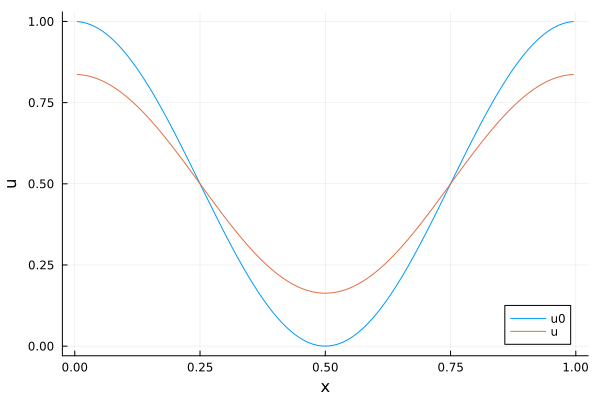
Sparse matrices
To use different matrix types for the production terms and linear systems, you can use the keyword argument p_prototype of ConservativePDSProblem and PDSProblem.
using SparseArraysp_prototype = spdiagm(-1 => ones(eltype(u0), length(u0) - 1), +1 => ones(eltype(u0), length(u0) - 1))prob_sparse = ConservativePDSProblem(heat_eq_P!, u0, tspan, μ; p_prototype = p_prototype)sol_sparse = solve(prob_sparse, MPRK22(1.0); save_everystep = false)plot(x, u0; label = "u0", xguide = "x", yguide = "u")plot!(x, last(sol_sparse.u); label = "u")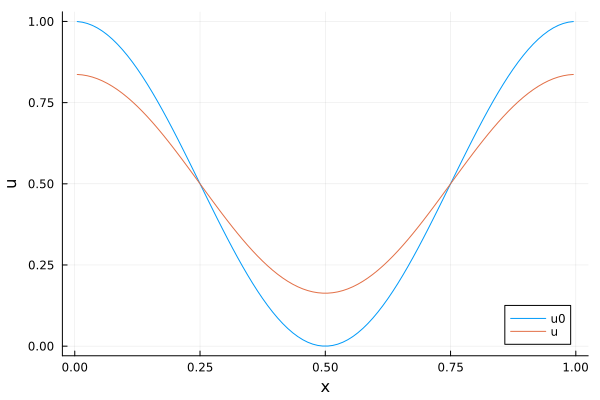
Tridiagonal matrices
The sparse matrices used in this case have a very special structure since they are in fact tridiagonal matrices. Thus, we can also use the special matrix type Tridiagonal from the standard library LinearAlgebra.
using LinearAlgebrap_prototype = Tridiagonal(ones(eltype(u0), length(u0) - 1), ones(eltype(u0), length(u0)), ones(eltype(u0), length(u0) - 1))prob_tridiagonal = ConservativePDSProblem(heat_eq_P!, u0, tspan, μ; p_prototype = p_prototype)sol_tridiagonal = solve(prob_tridiagonal, MPRK22(1.0); save_everystep = false)plot(x, u0; label = "u0", xguide = "x", yguide = "u")plot!(x, last(sol_tridiagonal.u); label = "u")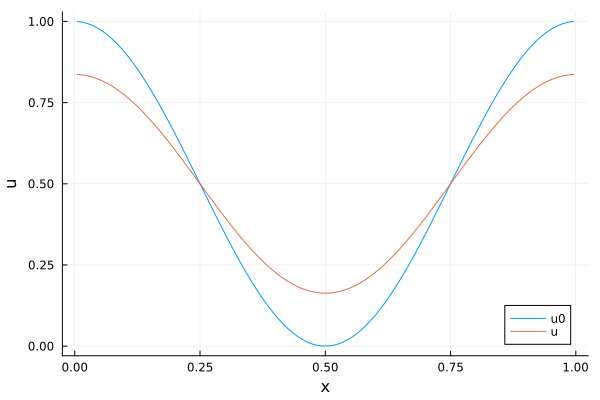
Performance comparison
Finally, we use BenchmarkTools.jl to compare the performance of the different implementations.
using BenchmarkTools@benchmark solve(prob, MPRK22(1.0); save_everystep = false)BenchmarkTools.Trial: 1425 samples with 1 evaluation per sample.
Range (min … max): 3.443 ms … 12.938 ms ┊ GC (min … max): 0.00% … 72.41%
Time (median): 3.496 ms ┊ GC (median): 0.00%
Time (mean ± σ): 3.510 ms ± 274.529 μs ┊ GC (mean ± σ): 0.27% ± 2.37%
▁▂█▅▆▇▆▅▃▅▁▂ ▃ ▁▁▂▂▂▂▄▁ ▃▂▁
▂▁▅▅▇████████████████████████████▇▃▄▅▄▄▅▄▃▃▄▂▁▂▁▁▁▁▁▁▁▂▂▁▂▁ ▄
3.44 ms Histogram: frequency by time 3.61 ms <
Memory estimate: 171.77 KiB, allocs estimate: 66.@benchmark solve(prob_sparse, MPRK22(1.0); save_everystep = false)BenchmarkTools.Trial: 1912 samples with 1 evaluation per sample.
Range (min … max): 2.326 ms … 3.934 ms ┊ GC (min … max): 0.00% … 27.58%
Time (median): 2.376 ms ┊ GC (median): 0.00%
Time (mean ± σ): 2.615 ms ± 535.739 μs ┊ GC (mean ± σ): 6.79% ± 10.42%
█▁
▅██▄▂▂▂▂▁▁▂▂▁▁▁▁▁▁▁▁▁▁▂▁▁▁▁▁▁▁▁▁▁▁▁▁▁▁▁▁▁▁▁▁▁▁▁▁▁▁▂▂▂▂▃▃▃▃▃ ▂
2.33 ms Histogram: frequency by time 3.88 ms <
Memory estimate: 4.77 MiB, allocs estimate: 2229.By default, we use an LU factorization for the linear systems. At the time of writing, Julia uses SparseArrays.jl defaulting to UMFPACK from SuiteSparse in this case. However, the linear systems do not necessarily have the structure for which UMFPACK is optimized for. Thus, it is often possible to gain performance by switching to KLU instead.
using LinearSolve@benchmark solve(prob_sparse, MPRK22(1.0; linsolve = KLUFactorization()); save_everystep = false)BenchmarkTools.Trial: 9129 samples with 1 evaluation per sample.
Range (min … max): 486.504 μs … 254.711 ms ┊ GC (min … max): 0.00% … 99.27%
Time (median): 503.509 μs ┊ GC (median): 0.00%
Time (mean ± σ): 547.446 μs ± 2.709 ms ┊ GC (mean ± σ): 6.98% ± 2.74%
▁▃▃▃▇█▇▇▄▂
▁▄███████████▇▇▆▆▅▄▃▂▂▂▂▁▁▁▁▁▁▁▁▁▁▁▁▁▁▁▁▁▁▁▁▁▁▁▁▁▁▁▁▁▁▁▁▁▁▁▁▁ ▃
487 μs Histogram: frequency by time 603 μs <
Memory estimate: 107.87 KiB, allocs estimate: 178.@benchmark solve(prob_tridiagonal, MPRK22(1.0); save_everystep = false)BenchmarkTools.Trial: 10000 samples with 1 evaluation per sample.
Range (min … max): 163.626 μs … 3.052 ms ┊ GC (min … max): 0.00% … 93.33%
Time (median): 166.932 μs ┊ GC (median): 0.00%
Time (mean ± σ): 179.484 μs ± 174.496 μs ┊ GC (mean ± σ): 6.00% ± 5.80%
▃▆██▅▁
▁▁▂▄▇██████▇▄▃▂▂▂▂▁▁▁▁▁▁▁▂▂▃▃▃▃▃▃▂▂▂▂▁▁▁▁▁▁▁▁▁▁▁▁▁▁▁▁▁▁▁▁▁▁▁▁ ▂
164 μs Histogram: frequency by time 186 μs <
Memory estimate: 133.77 KiB, allocs estimate: 395.Package versions
These results were obtained using the following versions.
using InteractiveUtilsversioninfo()println()using PkgPkg.status(["PositiveIntegrators", "SparseArrays", "KLU", "LinearSolve"], mode=PKGMODE_MANIFEST)Julia Version 1.13.0
Commit d1c37793dd2 (2026-09-09 19:00 UTC)
Build Info:
Official https://julialang.org release
Platform Info:
OS: Linux (x86_64-linux-gnu)
CPU: 4 × AMD EPYC 9V74 80-Core Processor
WORD_SIZE: 64
LLVM: libLLVM-20.1.8 (ORCJIT, znver4)
GC: Built with stock GC
Threads: 1 default, 1 interactive, 1 GC (on 4 virtual cores)
Environment:
JULIA_PKG_SERVER_REGISTRY_PREFERENCE = eager
Status `~/work/PositiveIntegrators.jl/PositiveIntegrators.jl/docs/Manifest.toml`
[14f7f29c] AMD v0.5.4
[4fba245c] ArrayInterface v7.30.2
[2569d6c7] ConcreteStructs v0.2.8
[ffbed154] DocStringExtensions v0.9.5
[4e289a0a] EnumX v1.0.7
[7034ab61] FastBroadcast v1.4.0
[46192b85] GPUArraysCore v0.2.0
[ba0b0d4f] Krylov v0.10.10
[2faa5264] LHLFactorization v2.2.2
[7ed4a6bd] LinearSolve v5.18.0
[46d2c3a1] MuladdMacro v0.2.7
[bbf590c4] OrdinaryDiffEqCore v4.18.0
[d1b20bf0] PositiveIntegrators v0.2.21 `~/work/PositiveIntegrators.jl/PositiveIntegrators.jl`
[d236fae5] PreallocationTools v1.7.1
[aea7be01] PrecompileTools v1.3.4
[21216c6a] Preferences v1.6.0
[0c0d3e7f] PureKLU v1.6.0
[3cdcf5f2] RecipesBase v1.3.4
[731186ca] RecursiveArrayTools v4.5.1
[189a3867] Reexport v1.2.2
[0bca4576] SciMLBase v3.55.0
[a6db7da4] SciMLLogging v2.1.0
[c0aeaf25] SciMLOperators v1.30.1
[53ae85a6] SciMLStructures v1.10.5
[efcf1570] Setfield v1.1.2
[a57abbd0] SparseColumnPivotedQR v2.1.8
[90137ffa] StaticArrays v1.9.22
[1e83bf80] StaticArraysCore v1.4.4
[10745b16] Statistics v1.11.5
[2efcf032] SymbolicIndexingInterface v0.3.55
[856f044c] MKL_jll v2025.2.0+0
[b77e0a4c] InteractiveUtils v1.11.0
[8f399da3] Libdl v1.11.0
[37e2e46d] LinearAlgebra v1.13.0
[d6f4376e] Markdown v1.11.0
[9a3f8284] Random v1.11.0
[9e88b42a] Serialization v1.11.0
[2f01184e] SparseArrays v1.13.0
[4536629a] OpenBLAS_jll v0.3.30+0
[bea87d4a] SuiteSparse_jll v7.10.1+0